Table of Contents
Before you start looking for an office for your team, as an Office Manager you need to bring together the needs of several people at once. Management sets the budget and timeline, HR looks at commuting, while the team explains how they actually work and what they need day to day. A well-prepared brief brings all of this information together and helps you rule out spaces that do not meet the basic requirements from the start.
In this guide, you will find a simple process and a ready-to-use office rental brief checklist that you can use when looking for a workspace for your team.
Serviced Offices – Flexible Offices for Rent
A serviced office in Wrocław – move your team in right away and leave the equipment, reception and day-to-day office support to us
VIEW READY-TO-USE SERVICED OFFICES IN WROCŁAWWhat should a well-prepared office rental brief help you achieve?
A good brief should first of all organise your company’s requirements before you start talking to workspace providers. It should make clear what is essential and what you can compromise on. This means several providers receive the same set of information, making it much easier to compare like-for-like proposals instead of completely different options.
The more you establish at the beginning, the fewer surprises you are likely to face after moving in. It is therefore worth checking the common mistakes companies make when renting an office that often only become apparent once the space is being used every day.
Step 1. Gather your company’s requirements before you start looking for an office
Do not try to guess what the company needs on your own. Bring together two perspectives: the business perspective – budget, timeline, lease period and growth plans – and the team perspective – how many people actually use the office, how often they are there and what they use it for.
Only once you have combined these two sets of information does it make sense to start looking at specific spaces.
Agree the budget, lease horizon and growth plans with management
Before asking about available offices, define the limits that an offer cannot exceed. This means more than the monthly rent. Include the total budget, one-off costs, the planned start date and how long you expect to use the space.
It is also worth clarifying your hiring plans. If the team could grow by several people within six months, decide whether the new office should include spare workstations or offer the option to move into a larger space. The same applies in the other direction – if the size of the team varies, the ability to reduce the amount of space may also matter.
Your brief should therefore include:
- the maximum total monthly budget;
- acceptable upfront costs;
- the expected number of people now and in the coming months;
- the expected lease period;
- the flexibility required to increase or reduce the size of the office;
- the latest date by which the team needs to start working from the new space.
Check how your team actually uses the office
The second perspective should come from the people who will actually use the space. Instead of asking a general question such as “what do you need from the new office?”, prepare a short survey based on everyday working habits.
Questions worth asking your team include:
- how many days a week do you work from the office;
- which days are you most often on-site;
- how much time do you spend on online calls;
- do you more often need quiet space or somewhere to work together;
- how do you commute to the office;
- how often do you meet clients on-site;
- what is missing from your current workspace.
These answers will tell you much more than job titles or department names alone. Two teams doing very similar work may use an office in completely different ways.
If you want to translate these findings into the office layout itself, see how to choose the right type of workspace for your team’s work style.
Step 2. Describe the work model and the real number of workstations you need
Do not simply write “the team has 24 people” in the brief. For a workspace provider, the more important question is how many of those 24 people will actually be in the office at the same time.
Look at your team’s working rhythm and include the following in the brief:
- the total size of the team;
- the number of people regularly working on-site;
- maximum office occupancy;
- the days with the highest attendance;
- the number of people working in a hybrid model;
- whether workstations should be assigned or shared;
- how the size of the team may change during the lease period.
A well-prepared brief should describe more than the total number of employees. It should show a realistic scenario for how the office will be used. This is what allows you to estimate the number of workstations and the amount of space you actually need.
If you want to calculate this in more detail, see how to calculate what kind of office your team actually needs.
Step 3. Define your location and commuting requirements
Office location affects the everyday logistics of your team, clients and business partners. It determines how quickly people can get there by public transport, where they can leave a car or bicycle, how long the journey from the railway station takes and whether the surrounding area is somewhere people are comfortable spending an entire working day.
Your brief should therefore define an acceptable area of the city and several practical requirements, including:
- access to public transport;
- parking requirements;
- access by bicycle;
- the importance of proximity to the railway station or airport;
- how often clients and partners visit the office;
- the importance of the surrounding area for employees;
- requirements relating to the character and presentation of the location.
Not every company will need the same thing. For one team, quick access to the city centre may be essential. For another, easy access by car or proximity to the airport may matter more.
If you have not yet decided on the location, it is worth resolving one basic question before adding it to the brief: an office in the city centre or on the outskirts? This will help you define not only where, but also why that location makes sense.
Step 4. List your requirements for space, equipment and support
At this stage, the brief needs to move from “we need a comfortable office” to specific requirements. Instead of general expectations, write down what your team should have available from day one.
Office space:
- number of private workstations;
- meeting rooms;
- space for online calls;
- shared areas;
- kitchen;
- space for guests;
- storage for documents and employees’ belongings.
Technology and access:
- internet and network requirements;
- printer and scanner;
- meeting room equipment;
- how the team can access the office outside reception hours;
- 24/7 access, if required.
Day-to-day support:
- cleaning;
- reception;
- welcoming guests and receiving deliveries;
- technical support;
- rules for using meeting rooms.
This list helps distinguish between simply renting floor space and choosing a solution where the workspace provider takes care of part of the day-to-day office organisation.
With serviced offices in Wrocław at IdeaPlace, the basic infrastructure and support include elements such as furniture, internet, cleaning, 24/7 access, administrative support and a meeting room package. It is still worth checking the exact scope of each offer before comparing it with other options.
Serviced Offices – Flexible Offices for Rent
A serviced office in Wrocław – move your team in right away and leave the equipment, reception and day-to-day support to us
VIEW READY-TO-USE SERVICED OFFICES IN WROCŁAWStep 5. Describe the budget in a way that makes offers comparable
Simply writing “budget up to X per month” tells you very little if one offer includes most operating costs while another only shows the base rent.
Your brief should therefore specify:
- the maximum total monthly cost;
- whether the budget should include utilities and service charges;
- the maximum upfront cost;
- deposit requirements;
- any fit-out and equipment costs;
- meeting rooms or parking charged separately.
It is also important to define the period over which you are comparing costs. An offer that looks attractive in the first month may look very different when calculated over a full year.
A good brief should help you compare more than the headline rate. It should allow you to compare the real cost of using the office over the same period and for the same scope of services.
If you want to break this down in more detail, see what really makes up the cost of renting an office and which expenses are easiest to overlook when comparing offers for the first time.
Step 6. Provide the start date and the flexibility you expect from the agreement
The brief should also specify when your team wants to start working, the latest acceptable move-in date and whether you need access to the space beforehand, for example to prepare workstations, install equipment or organise the move.
The expected lease period is just as important. State whether the company needs the space for a few months, for longer or does not yet know exactly when the arrangement will end. It is also worth specifying whether you need the option to change the amount of space as the size of the team changes, as well as what notice period would be acceptable.
At IdeaPlace, offices are fully furnished and ready to use, while the offer allows for flexible rental periods – from short stays to months or years – and the option to change the space as the company grows.
Step 7. Ready-to-use checklist – what should you send to the workspace provider?
At this stage, it is worth bringing all the previous decisions together in one short document. The less room you leave for assumptions, the more likely you are to receive offers based on a comparable scope.
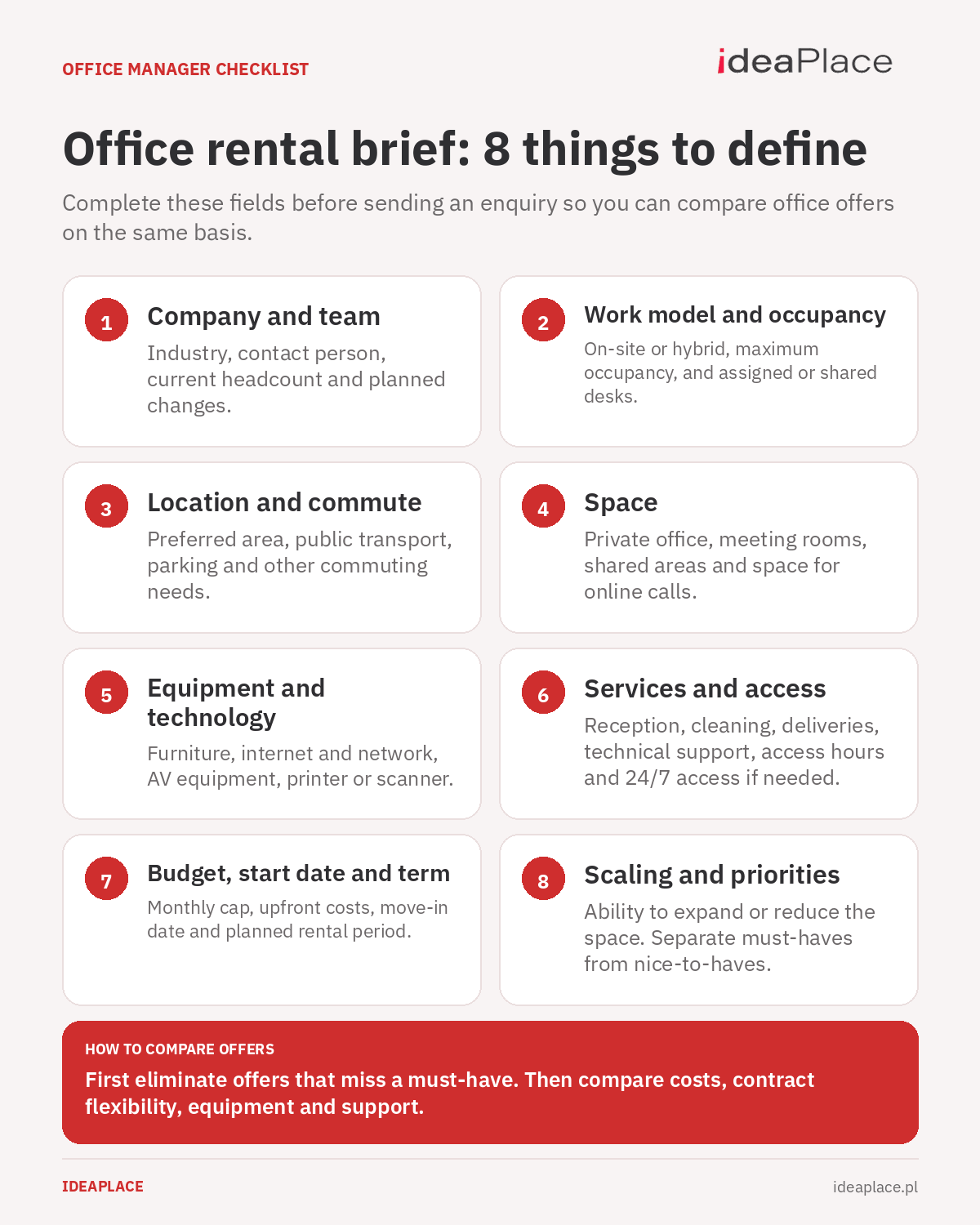
You can simply copy and complete the structure below:
| Brief item | What to include |
| Company | industry, number of people, contact person |
| Team | current number of people + expected changes |
| Work model | office-based / hybrid / other |
| Occupancy | maximum number of people in the office at the same time |
| Workstations | assigned / shared |
| Location | preferred area, commuting, parking |
| Space | private office, meeting rooms, shared areas |
| Equipment | furniture, internet, AV, printer/scanner |
| Support | reception, cleaning, deliveries, technical support |
| Access | required access hours, including 24/7 access if necessary |
| Budget | monthly limit and one-off costs |
| Start date | move-in date |
| Period | expected length of use |
| Scaling | option to increase or reduce the amount of space |
| Must have | non-negotiable requirements |
| Nice to have | additional features |
Example of a short Office Manager brief
We are looking for an office for a team of 18 people currently working in a hybrid model. Usually 10–14 people are on-site, with the highest occupancy on Tuesdays and Wednesdays. We need a private workspace, at least one meeting room and somewhere to take online calls. Good public transport connections are important, as is a location that allows people from different parts of the city to commute conveniently.
The office should be furnished, have reliable internet and access to a printer, as well as reception and delivery handling. We would prefer access outside standard office hours. The maximum monthly budget should include basic operating costs and amount to no more than [amount] net. We want to start working from the office no later than [date] and expect to use the space for at least [period]. It is important that we can expand the office if the team grows during the agreement.
How should you compare office offers once proposals start coming in?
Once the first proposals arrive, it is easy to fall into the trap of comparing a single number: the monthly price. The problem is that two offers with a similar rent may include completely different things.
Start by checking whether each space meets all your must-have requirements. Only then compare costs, agreement flexibility, equipment and support. An offer that fails one of your essential requirements should not win simply because it is cheaper.
The simplest approach is to collect the answers in one table:
- Meets all must-have requirements
- Total monthly cost
- Upfront costs
- What is included in the price
- Additional charges
- Availability from the required date
- Option to increase or reduce the space
- Agreement length
- Notice period
- Equipment
- Reception and support
- Location and commuting
This format quickly shows where the differences are only superficial and where they genuinely affect the team’s day-to-day experience or the company budget. It allows you to choose an offer based on the whole package rather than one attractive-looking figure.
Traditional lease or serviced office? Your brief should point you towards the answer
A well-prepared brief will often show you which model is worth considering. If your requirements are stable and your company is ready to organise and manage the office itself, a traditional lease may be an option. If a ready-to-use space, equipment and day-to-day support matter more, it makes sense to consider a serviced office.
You can find a broader comparison in our guide to choosing between a serviced office, flex office and traditional lease.
If your brief shows that the team only needs a shared workspace from time to time, another option may be coworking for teams. At IdeaPlace, this option is available for groups of up to 12 people, including project work and recurring days when the team works together on-site.
Brief ready? Explore IdeaPlace offices in Wrocław
Have you already written down the key requirements? Send them to IdeaPlace and see which offices for rent in Wrocław match what your team actually needs.
At Plac Solny 15, you will find ready-to-use, furnished spaces with internet, cleaning, professional reception support and 24/7 access. Instead of starting the conversation with “what do you currently have available?”, you can begin with your brief and work with us to choose an option that actually fits.
Would you like to try our office spaces in practice first? Join us for a free trial day at IdeaPlace. Contact us and choose a date that works for you.
Serviced Offices – Flexible Offices for Rent
A serviced office in Wrocław – move your team in right away and leave the equipment, reception and day-to-day support to us
VIEW READY-TO-USE SERVICED OFFICES IN WROCŁAW
Ewa Rogoż
Ewa Rogoż is an experienced coworking pioneer in Wrocław and the founder of IdeaPlace – the first professional coworking space in Lower Silesia. Her dedication to business development and support for entrepreneurs led to the creation of an inspiring space in the heart of the city. Ewa not only creates coworking spaces for freelancers but also micro-offices for small teams, thereby supporting diverse business initiatives in the region.