Table of Contents
A sprinkler system leak, a power cut or a building manager’s decision to close the property for renovation – none of these situations waits for permission. In February 2026, an incident of this kind forced a Warsaw office building to be evacuated without warning, leaving dozens of companies unable to access their offices from one day to the next.
Need a ready-to-use space that helps your team return to work quickly? Explore private, fully equipped offices in central Wrocław with 24/7 access.
This was not an isolated technical failure. Poland’s office stock is ageing and shrinking: in Warsaw alone, more than 500,000 sq m of office space has been withdrawn from use over the past five years, while hundreds of thousands of additional square metres are awaiting refurbishment or demolition. For a company, this means one thing: the question is not whether its premises may become unavailable, even for a few days, but when.
The good news is that you do not have to respond in a panic. All you need is a simple plan: know who must be able to work from day one, how many workstations you need and where to find them. This article explains how to prepare that plan step by step, without paying for an expensive duplicate of your main office.
Serviced Offices – Flexible Offices for Rent
A serviced office in Wrocław — move your team in right away and leave the equipment, reception and day-to-day office support to us.
VIEW READY-TO-USE SERVICED OFFICES IN WROCŁAWWhy does your company need a workplace Plan B?
An office failure rarely resembles a scene from a disaster film. It usually starts with what sounds like a routine technical fault: a damaged pipe, a malfunctioning fire safety sensor or an electrical short circuit. The operational impact, however, is the same: your team loses access to its desks and infrastructure.
A useful recent example is the office building at 18 Twarda Street in Warsaw, where a sprinkler system failure flooded the lobby and caused part of the suspended ceiling to collapse. The property had to be taken out of use for fire-safety reasons and everyone working there was evacuated. It shows how a seemingly minor installation problem can become an operational challenge for every tenant in the building within moments.
Poland has no single central register of failures in commercial buildings. Information is scattered across press reports and insurers’ records. The lack of consolidated statistics, however, does not reduce the risk.
It is also worth remembering that a backup workplace is useful for more than unexpected emergencies. The commercial property market is changing rapidly: older buildings are being refurbished, redeveloped or withdrawn from use. Market data analysed by Colliers and JLL shows that hundreds of thousands of square metres of office space disappeared from Poland’s metropolitan markets between 2020 and 2025, while further properties in cities such as Wrocław and Warsaw are being prepared for redevelopment.
For operations teams, the conclusion is clear: a contingency plan is not only protection against a burst pipe. It is also a smooth bridge during a renovation, lease renegotiation or office move.
What is a backup office?
A backup office is a workplace selected in advance, to which a company can move part or all of its team when its main premises become unavailable. It is not intended to reproduce the main office one-to-one. Its purpose is to provide the minimum required to keep critical processes running.
For one company, this may mean a private office for several customer-facing employees. For another, it could be a dozen desks, reliable internet access and a room for daily briefings. A team that can perform most tasks remotely may need only a place for meetings, document-based work or access to equipment that employees do not have at home.
That is why asking, “How can we recreate our entire office?” leads in the wrong direction. A better question is: which people and processes must be operational from day one?
A temporary office and a professional Disaster Recovery Office
These terms are often grouped together, although in practice they represent very different approaches to budgeting and logistics.
A Disaster Recovery Office (DRO) is used mainly by financial institutions and corporations subject to strict regulatory requirements. It normally means maintaining and paying for permanent backup workstations that can be activated in line with defined service-level commitments. This generates substantial ongoing costs.
A flexible temporary office addresses a simpler but more common need. It provides a ready-to-use workspace, equipment and operational facilities during a failure, renovation or move. It can be an important part of your contingency plan, but it does not replace data backups, IT disaster recovery or cybersecurity procedures. It solves the workplace problem, not the data problem.
When might you need an alternative workplace?
It is worth preparing or testing a backup office plan when any of the following situations may occur:
- utility outages or building failures: an extended power cut, air-conditioning failure during hot weather or flooding;
- refurbishment work: noisy renovation in neighbouring premises, disruptive dust or planned replacement of installations in your building;
- fit-out delays: your previous lease has ended, but your new premises are not yet ready for handover. If you are preparing to relocate, read our guide on how to plan a move to a new office without chaos, downtime and uncontrolled costs;
- separate projects and special assignments: a distributed project team needs to work together in one place during a critical period.
How to prepare a backup office plan step by step
Instead of creating a complicated document that will disappear into your company archive, focus on a set of practical steps.
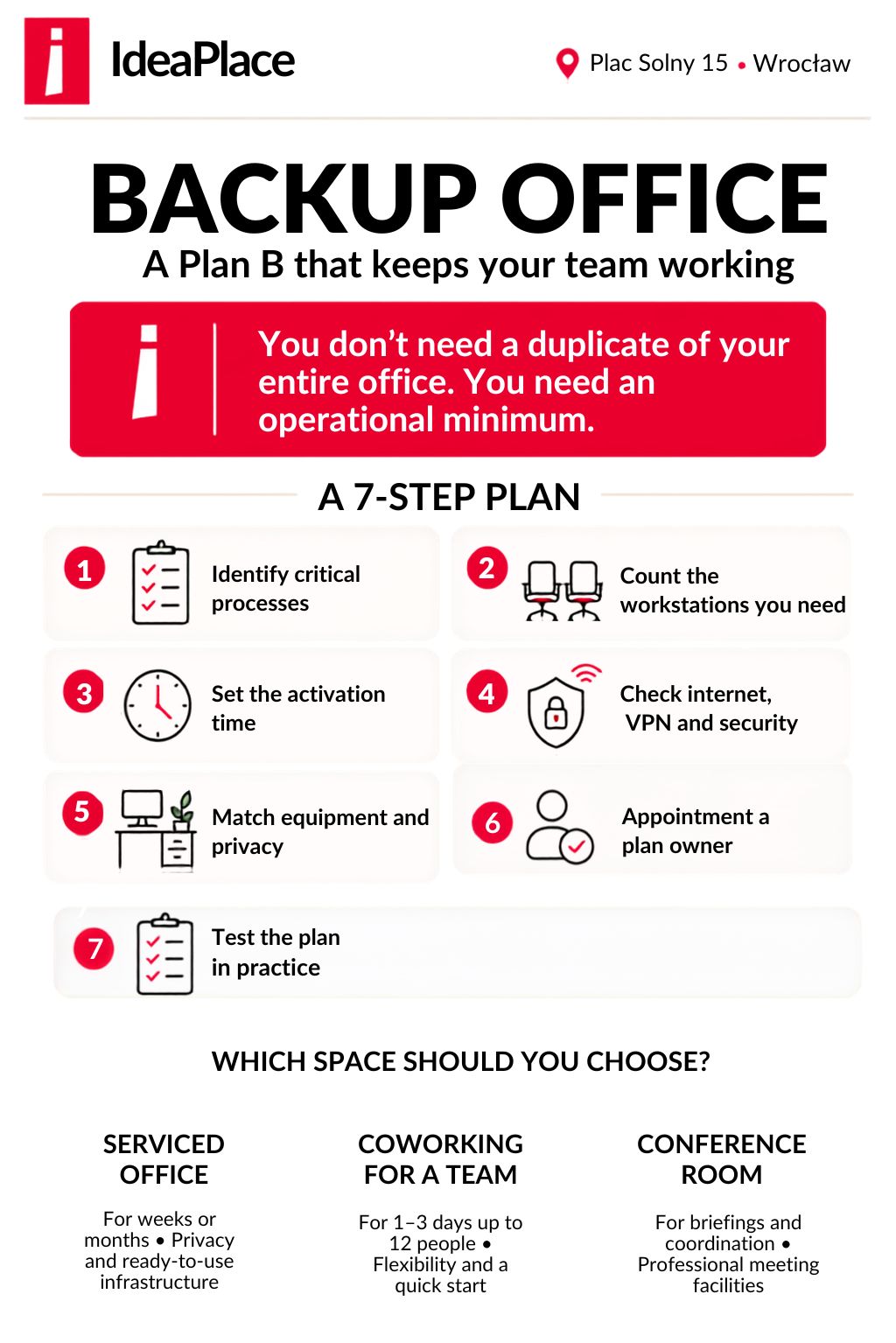
1. Identify the processes that cannot wait
Determine which functions cannot stop working for even 24 hours. These will often include customer service, sales, operational accounting or key engineering roles. The rest of the team may be able to work from home temporarily.
2. Define the minimum number of workstations
Do not reserve space for 100% of your workforce. Some people may work remotely for several days while the critical team uses a temporary office. Divide the team into two groups:
- operational minimum: the people required to maintain critical processes;
- scale-up group: additional workstations you can add if the disruption at your main office lasts longer than expected.
For a more structured approach, see how to calculate what kind of office your team actually needs.
3. Set your required activation time and likely duration
Decide whether the space must be available on the same day, the following morning or within a few days. Then estimate how long you may need it: one day, one week, one month or until the renovation is complete.
These two answers directly affect the type of space you should choose. A one-day coordination meeting requires a very different setting from daily team work involving documents and confidential conversations.
If the workspace operator does not guarantee an activation time in the agreement, do not assume that availability is assured. Agree on a contact person in advance and decide how you will quickly confirm which spaces are free.
4. Check internet access, systems and security
A desk and chair are of little use if employees cannot log in to the systems they need. Make sure that:
- every employee has a configured VPN and secure two-factor authentication;
- access to paper documents is protected or the documents have been digitised;
- the team understands how to use public or third-party internet networks safely.
Planning a backup office for your team? A ready-to-use private space with fast internet and complete office facilities shortens the path from decision to work.
Serviced Offices – Flexible Offices for Rent
A serviced office in Wrocław — move your team in right away and leave the equipment, reception and day-to-day office support to us.
VIEW READY-TO-USE SERVICED OFFICES IN WROCŁAW5. Check the equipment and working conditions
Look beyond the number of desks. Your team may need monitors, lockable cabinets, a printer, video-conferencing equipment, kitchen facilities, air conditioning or round-the-clock access.
The layout of the space also matters. People speaking with clients need privacy, while a project team needs room to work together and hold short briefings.
6. Prepare communications and access instructions
Confusion is the greatest enemy of an effective response. Appoint one person, such as an Office Manager or Operations Manager, to send the team clear instructions: where to go, how to enter the new building and whom to contact if a problem arises on site.
7. Test the plan before you need it
A test does not have to involve moving the entire company. Ask a few key people to spend one working day at the chosen location and check access, internet connectivity, connections to company systems, privacy and comfort during calls, and commuting time. Their feedback will quickly reveal any gaps in the procedure.
Which type of space should you choose for your team?
Not every alternative workplace meets the same needs. Your choice should depend on the number of people, expected duration, confidentiality requirements and how the team works together.
Private serviced office
This option works well when a team needs a regular workplace for several weeks or months, handles confidential conversations or requires a consistent workstation layout. A ready-to-use serviced office in Wrocław reduces the organisational workload on your side: the space is furnished, the internet works from day one, and office facilities and support are already in place.
Before making a decision, always confirm the available floor area, number of workstations, start date and scope of services.
Coworking space for a team
If you need a space for one or several days, work on a project basis or want to bring a smaller team together in one place, flexible coworking for teams in Wrocław may be the right choice. At IdeaPlace, teams of up to 12 people can use this option through either a one-off or recurring package.
Coworking will not replace a private office in every situation. If employees hold confidential conversations, work with sensitive documents or require permanent access to particular equipment, a dedicated private space will usually be a better fit.
Room for briefings and incident-response meetings
Sometimes most of the team can work remotely, while only the people coordinating the response need a shared space. In that case, conference rooms in central Wrocław can serve as a base for daily briefings, client meetings or workshops where the team agrees on its next steps.
| Option | Best suited to | Key benefit |
|---|---|---|
| Serviced office | Regular work for several weeks or months; confidential conversations | Full privacy, a dedicated office and ready-to-use infrastructure from day one |
| Coworking for a team | Project work; rapid support for 1–3 days; teams up to 12 | Flexibility, no long-term commitment, fast start and infrastructure included in the package |
| Conference room | Briefings, client meetings, coordination and management meetings | Professional multimedia facilities and a representative setting |
How can IdeaPlace support your team in Wrocław?
When looking for a backup workplace, it makes sense to choose an experienced partner who understands how quickly business needs can change. IdeaPlace is not an anonymous corporate office chain. It is Wrocław’s first boutique coworking space, operating continuously since 2011.
You will find us in an atmospheric historic townhouse at Plac Solny 15, just off Wrocław’s Market Square. It is a convenient city-centre location that employees and business partners can easily reach from across the city.
Depending on availability and your team’s needs, you can use a private serviced office, coworking space for a team or a room for meetings. The facilities include furnished workstations, high-speed internet, a kitchen, air conditioning, office equipment, cleaning and support from the IdeaPlace team. Serviced offices are also available with 24/7 access.
The key is flexibility. Instead of forcing your contingency plan into a single fixed package, first define the number of people, the type of work and the expected duration. Then talk to us about the space that will fit those needs.
IdeaPlace can be part of your contingency plan, but the activation of a specific space always depends on current availability and prior agreement. If business continuity is critical to your company, discuss the arrangements in advance rather than looking for a workplace only after your premises have closed.
Checklist: is your backup office plan ready?
- ☐ Have you appointed the decision-maker authorised to activate the backup office procedure?
- ☐ Have you identified the employees who must work on site from day one?
- ☐ Have you defined the minimum number of desks and private rooms required?
- ☐ Does the chosen space provide sufficient privacy, internet access and equipment?
- ☐ Does the plan cover both a one-day disruption and a longer interruption?
- ☐ Have employees tested remote access to company systems, and are data backups up to date?
- ☐ Has the solution been tested in practice?
- ☐ Does the plan have an owner and a date for its next review?
- ☐ Do you know your contact person at the workspace operator?
- ☐ Do employees know how they will receive travel and entry instructions?
- ☐ Have you prepared message templates for clients and employees to use during a disruption?
Backup office: frequently asked questions
Does every company need a backup office?
Not every company needs a permanently reserved second location. Every company should, however, know how it will operate after losing access to its main office. For a small business, remote work supplemented by several desks and a meeting room may be enough. A larger team may need a ready-to-use private space.
How many workstations should a backup office have?
Enough to maintain critical processes during the first few days. Instead of copying the number of workstations at your main office, define an operational minimum and an expanded option in case the disruption lasts longer.
Can a coworking space serve as a backup office?
It can form part of a contingency plan, particularly for a smaller team and a short period. Check availability, privacy, access rules, security requirements and equipment. A private office is usually more suitable when confidential data is involved.
Is a serviced office suitable during a renovation?
Yes. It is furnished and its infrastructure is already operational, so you do not have to arrange another fit-out, internet connection and office facilities from scratch. Before signing an agreement, confirm the start date, number of workstations, rental period and included services.
How quickly can a temporary office be activated?
With ready-to-use serviced spaces such as IdeaPlace, the formalities are kept to a minimum. If suitable space is available, your team can start working almost immediately after the terms have been agreed.
Prepare the space before you need it
A good contingency plan is not about predicting every possible failure. It should give your team a simple answer: who takes action, where they work and what they need to keep critical processes running.
If you are looking for flexible space during a renovation, move or unexpected interruption, explore the offices available for rent in Wrocław. Let us talk about your Plan B. Tell us how large your team is and what working conditions you need. We will check the availability of offices and meeting rooms at Plac Solny 15 so that your company can maintain operational continuity.
Prepare your Plan B before you need it. Explore IdeaPlace serviced offices and talk to us about the number of workstations, timing and working conditions your team requires.
Serviced Offices – Flexible Offices for Rent
A serviced office in Wrocław — move your team in right away and leave the equipment, reception and day-to-day office support to us.
VIEW READY-TO-USE SERVICED OFFICES IN WROCŁAW
Ewa Rogoż
Ewa Rogoż is an experienced coworking pioneer in Wrocław and the founder of IdeaPlace – the first professional coworking space in Lower Silesia. Her dedication to business development and support for entrepreneurs led to the creation of an inspiring space in the heart of the city. Ewa not only creates coworking spaces for freelancers but also micro-offices for small teams, thereby supporting diverse business initiatives in the region.