Table of Contents
The latest market trends for 2026 show that nearly 70% of us consider remote or hybrid work to be our top priority. This is significantly changing the role of the traditional office. More and more often, companies are choosing flexible spaces that enable face-to-face meetings while also bringing dispersed teams together and supporting business growth.
Coworking in Wrocław – rent a workspace without a contract
Schedule a free trial dayHow is the evolution of the hybrid work model affecting the demand for on-demand offices?
Hybrid work is changing the way we use offices. Teams come into the office an average of 2.4 days a week, which means that half of the desks sit empty. As a result, companies in Poland are now renting offices that are, on average, 20–30% smaller than before the pandemic (in Warsaw alone, the average lease has shrunk from 1,000 m² to 800 m²).
On the other hand, companies cannot completely do away with in-person meetings – OECD research shows that a forced return to offices risks losing top talent, but a cohesive team still needs occasional in-person meetings.
The solution to this stalemate is switching to on-demand leasing, which allows companies to use offices only when needed and easily scale space according to the team’s needs. As many as 64% of surveyed companies recognize the benefits of this model, a contract for ready-to-use, serviced space can be signed for as little as a month and scaled freely. Companies often invest the savings into employee standards and well-being, for example, by choosing smaller offices in better locations, providing ergonomic furniture, or creating relaxation zones.
What are the employment trends in Poland and the U.S.?
In 2026, we are witnessing a sharp clash between employee expectations and policies on returning to the office. In the U.S., tech giants are setting the tone; for example, Amazon has mandated a return to the office five days a week, allowing remote work only in exceptional circumstances. Similarly, the U.S. government requires civil servants to be present in the office even if they live more than 80 kilometers away.
In Poland, meanwhile, as many as 84% of large companies plan to implement a full return to in-office work within the next three years. However, employers are not doing this because of a decline in productivity. The main motivations of management are:
- the desire to facilitate supervision,
- improved communication,
- rebuilding organizational culture,
- and easier compliance with regulations.
Remote, hybrid, or in-office work? What are the proportions?
However, management’s vision does not align with how we want to work today. Already, 37% of organizations in Poland strictly require employees to be fully present on-site, while a complete return to in-office work is the preferred model for just 6% of employees.
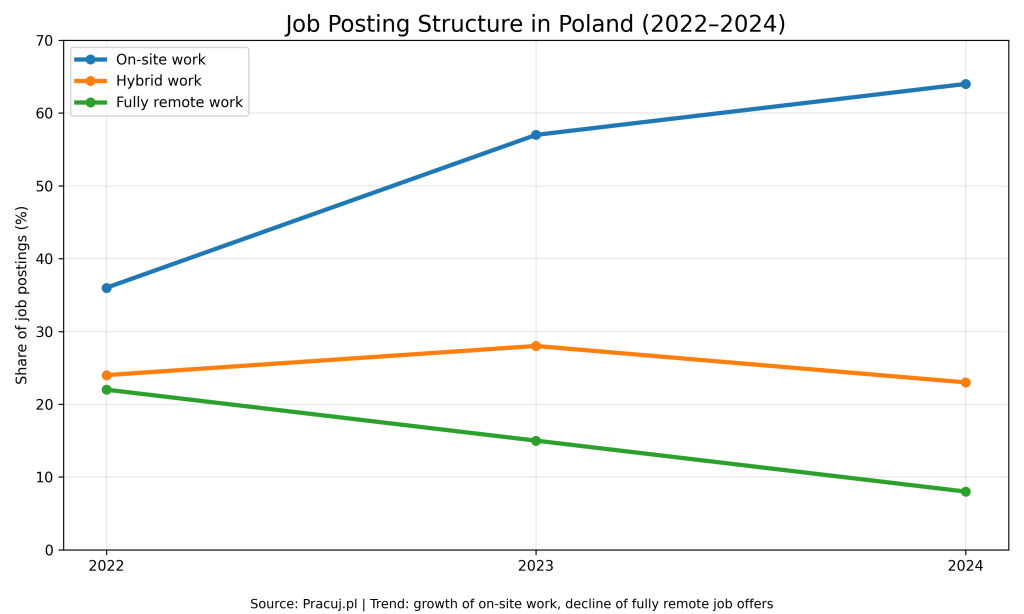
According to statistics from the Pracuj.pl platform, the structure of job postings in Poland underwent a massive shift between 2022 and 2024:
| Year | On-site work* | Hybrid work** | Fully remote work*** |
| 2022 | 36% | ~24% | 22% |
| 2023 | 57% | 28% | 15% |
| 2024 | 64% | 23% | 8% |
*On-site work – requires daily physical presence at a specific location, precluding remote work from another location;**Hybrid work – a combination of working from home and the requirement for physical presence (e.g., 2–3 days in the office). This model assumes a central hub in the form of a local base office; ***Fully remote work – 100% home office with no requirement to be present in the office (we do not include negotiable flexibility in this breakdown).
Why do remote teams lose their innovative potential without regular face-to-face meetings?
Working entirely from home also poses a risk to team innovation. The lack of spontaneous interactions limits knowledge sharing and hinders mentoring. Teams lose “tacit knowledge,” and organizational culture deteriorates as many as 33% of companies note a progressive weakening of team bonds. Regular meetings in rented spaces allow teams to rebuild energy, creativity, and relationships that cannot be maintained through messaging apps.
What are the benefits of renting an office for meetings?
That is why renting a meeting space is currently the simplest way to combine the convenience of remote work with the power of face-to-face collaboration. Offices are no longer just for individual work they are becoming places for exchanging ideas, holding meetings, and sharing a cup of coffee. As many as 62% of employees openly admit that the greatest value of an office is precisely the ability to work with people face-to-face.
Especially in knowledge-based industries, such as IT or finance, maintaining a huge open-plan space is counterproductive. Companies are cutting their long-term office leases by as much as 30–40% and converting rigid, long-term capital costs into a flexible subscription model, renting dedicated rooms by the day or hour exclusively during peak occupancy periods and team meetings.
How does the physical office space stimulate creative processes and brainstorming?
The space we occupy directly influences our creativity and overall operational effectiveness. A physical office is the only environment that fosters so-called serendipitous encounters chance, informal meetings in the hallway or by the coffee machine, which often yield the best ideas.
Constant remote work, on the other hand, can create a “proximity bias.” We often subconsciously favor and rate more highly those team members we see in person more frequently. Regular in-person gatherings of the entire team simply level the playing field and build healthy relationships.
Companies are well aware of this problem, which is why they are increasingly organizing quarterly sync days or intensive workshops in external spaces. Getting together on neutral ground, free from home or corporate routines, is a powerful boost of new energy for the brain. At IdeaPlace, we provide you with the perfect conditions for this without any pretentiousness, but with an atmosphere that naturally inspires action.
How can you optimize your company’s operating costs with flexible office space rental?
Traditional offices generate high costs in a hybrid model. On-demand leasing allows you to pay only for the space you actually use. Coworking spaces offer fully furnished, ergonomic spaces with reception and administrative support, which saves money and lightens the workload on your team.
Flexibility, convenience, and cost savings – renting an office for meetings
Serviced agreements can be signed for as little as one month, and the number of workstations can be adjusted instantly to meet your team’s needs. Professional service and a ready-to-use space reduce day-to-day tasks and allow companies to operate more flexibly.
Market data confirms the growing popularity of flexible spaces. In the U.S., there were 9,136 coworking locations in the first quarter of 2026, and the segment is valued at $5.38 billion, with a projected growth to $7.79 billion by 2031. In Poland, for example in Warsaw, the total supply of flex space exceeds 205,000 m² (25,000 workstations), and at the turn of 2025/2026, developers delivered an additional 6,000 m² in response to growing demand.
How can you effectively make the case for implementing on-demand office space to management?
Discussing a change in spatial strategy with management requires solid financial arguments. Maintaining a huge, permanent office for a hybrid team is simply a waste of budget.
Just consider the “anchored hybrid” model, where employees typically only show up at the office from Tuesday to Thursday. This creates organizational chaos by midweek, there are no available rooms or spaces for focused work, while on Mondays and Fridays, the office maintained at enormous cost stands empty.
Switching to on-demand leasing provides immediate relief for the company budget. The argument is simple: you reduce the square footage and pay only for the time your team actually uses the space.
What standards should a modern coworking space for businesses meet in 2026?
The evolution of the work model has led modern coworking spaces to move away from noisy, large open-plan areas in favor of modular layouts that offer greater privacy. Today, a growing market standard is also a focus on employee well-being—ergonomic furniture, maximizing natural light, living greenery, and relaxation zones that provide real comfort and a breather throughout the day.
A modern office space for business should also allow for seamless adjustment of the office’s scale to current needs without tying up capital. Companies are looking for on-demand solutions that allow them to start working immediately without incurring costs for interior design, renovations, or equipment purchases.
Why is a downtown office location crucial for a team’s image and logistics?
Choosing a meeting place for a distributed team is about more than just a nice view from the window. In a hybrid work environment, the office location becomes a strategic tool that directly impacts the company’s image.
City centers remain the most important operational hubs in the country. This is clearly evident in Warsaw, where as much as 72% of the space leased by flexible workspace providers is located right in the heart of the city.
Having a presence in key urban markets such as Warsaw, Kraków, Wrocław, or Gdańsk gives companies immediate access to the largest business infrastructure and allows them to outcompete rivals on several fronts:
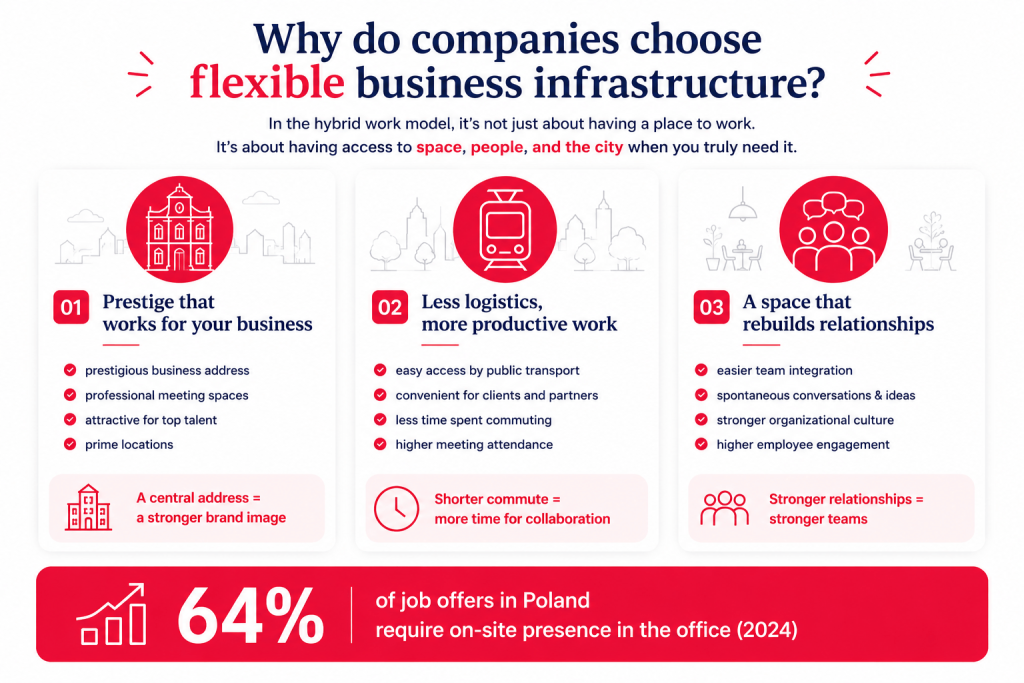
- company prestige and image – by choosing office spaces in prestigious locations, whether in modern Class A office buildings or historic stone buildings, you create a professional setting that elevates your brand’s standing in the eyes of clients and top talent;
- simpler logistics and time savings – in dispersed teams, employees often commute from different neighborhoods, whereas a location in the very heart of the city guarantees proximity to key public transportation hubs, train stations, and parking lots;
- a catalyst for after-hours organizational culture – the proximity of restaurants and cafes in the city center allows for a seamless transition from formal discussions to casual bonding, which is the most effective way to rebuild social capital weakened by working from home.
How does IdeaPlace solve the logistical challenges faced by distributed hybrid teams?
The changing role of the traditional office is a result of the rise of the hybrid model and a new definition of productivity. For distributed teams that meet occasionally for workshops or project rollouts, flawless logistics and flexibility are essential. Traditional, long-term lease agreements, in the face of fluctuating attendance, simply generate unnecessary fixed costs today.
At IdeaPlace, we combine technological and budgetary requirements with the unique, boutique atmosphere of a Wrocław townhouse. We offer a modern business solution in the spirit of the “Core + Flex” strategy. As a pioneer of coworking in Wrocław, we have been combining professionalism with an authentic atmosphere since 2011, proving that flexible spaces are the best mechanism for optimizing expenses and agile team management.
With us, you can work your way—we’ll take care of the rest.
Coworking in Wrocław – rent a workspace without a contract
Schedule a free trial day
Ewa Rogoż
Ewa Rogoż is an experienced coworking pioneer in Wrocław and the founder of IdeaPlace – the first professional coworking space in Lower Silesia. Her dedication to business development and support for entrepreneurs led to the creation of an inspiring space in the heart of the city. Ewa not only creates coworking spaces for freelancers but also micro-offices for small teams, thereby supporting diverse business initiatives in the region.